
Selling travel today is no longer about offering the lowest price. It’s about responding faster, personalizing journeys, following up consistently, and delivering a smooth experience from enquiry to booking. Travel agencies that struggle to scale sales often don’t have a demand problem; they have a system problem. This is where choosing the right Travel Agency CRM becomes critical. Not every CRM is built for the complexities of travel sales, multiple passengers, custom itineraries, vendor coordination, quotations, and long decision cycles. A generic CRM may store leads, but the right CRM for your travel business actively helps you convert more enquiries into confirmed bookings.
In this blog, we’ll break down how to choose the right the right CRM for your travel agency for 2X your sales, focusing on the features that directly impact conversion, efficiency, and scalability, without repeating what you’ve already seen in typical travel CRM discussions.
Many travel agencies adopt a CRM with high expectations, yet struggle to see meaningful results over time. In most cases, the problem is not the intent to digitize, it’s the choice of a system that doesn’t align with how travel sales actually work. Travel businesses deal with complex itineraries, multiple travelers per trip, long decision cycles, and constant follow-ups. A generic CRM often fails to support these realities, creating friction instead of efficiency.
When agencies operate with an ill-suited system, everyday sales activities become harder rather than smoother. Instead of accelerating conversions, the CRM adds manual work and disconnects teams. This directly impacts response time, customer experience, and ultimately revenue.
Common challenges of choosing the wrong CRM include:
The right Travel Agency CRM eliminates these gaps by supporting real travel sales workflows. It adapts to how agencies sell trips, nurture leads, and close bookings, helping teams work faster, stay organized, and scale sales without increasing effort.
Travel enquiries rarely follow a straight path. Some travelers browse options for months, while others look to confirm quickly. The right CRM must reflect this reality by helping teams capture, qualify, and prioritize leads based on intent, urgency, and trip complexity. When lead management aligns with how travel sales actually work, consultants respond faster and engage prospects more meaningfully.
Instead of treating every enquiry the same, a well-designed CRM gives agents complete visibility into each traveller’s requirements and journey. This clarity allows teams to focus on high-intent leads while continuing to nurture early-stage enquiries without losing momentum.
Key capabilities to look for in the right Travel Agency CRM include:
When agents spend less time organizing data and more time advising travellers, conversion rates improve, bringing agencies closer to their 2X sales growth goal.
Travel businesses don’t sell products, they sell experiences. A single customer may enquire about multiple trips over time, each with different destinations, budgets, and timelines. The right Travel Agency CRM must support this reality by managing trips as independent records rather than forcing everything under one generic contact.
A trip-centric CRM structure allows teams to track, quote, and manage every inquiry separately while still maintaining a complete view of the customer relationship. This eliminates confusion when the same traveller explores multiple options and ensures every opportunity receives the attention it deserves.
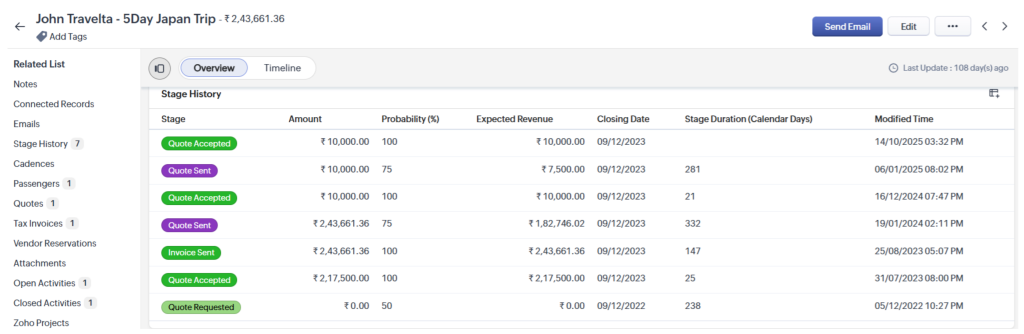
With a trip-focused approach, the right Travel Agency CRM enables agencies to:
By aligning CRM design with real travel sales workflows, agencies avoid missed opportunities and operate with greater clarity, especially when travellers enquire multiple times before confirming a booking.
In travel sales, speed and clarity around proposals often determine whether an enquiry converts or goes cold. When quotations are scattered across emails or stored outside the CRM, teams lose visibility, follow-ups slip, and customers feel uncertain. The right Travel Agency CRM removes this friction by bringing proposal management directly into the sales workflow.
A well-designed CRM allows agents to create, track, and refine proposals without switching tools or duplicating work. Every quotation stays linked to the relevant trip, giving teams complete context at every stage of the decision-making process.
With the right Travel Agency CRM, agencies can:
When proposals remain organized and follow-ups happen at the right time, travellers feel supported rather than pressured, building trust and accelerating conversions.
Travel sales rarely close in a single conversation. Most bookings require timely reminders, clarification on itineraries, and consistent yet thoughtful follow-ups. When teams rely on manual reminders, enquiries often go cold, especially during busy seasons, leading to lost revenue. The right Travel Agency CRM solves this by automating follow-up management without losing the personal touch.
A CRM built for travel sales keeps follow-ups structured, visible, and accountable. Agents know exactly when to reconnect, and managers gain confidence that no enquiry is left unattended.
A strong Travel Agency CRM should support:
By systemizing follow-ups, agencies convert more enquiries with the same team size, turning consistency into a reliable growth driver.
Personalization sits at the core of successful travel sales. Today’s travellers expect agents to understand their preferences, remember past trips, and anticipate their needs without asking the same questions repeatedly. A fragmented system makes this difficult, but the right Travel Agency CRM brings every customer detail into one unified view.
By centralizing customer data, agents gain full context before every interaction. This allows conversations to feel consultative rather than transactional, building trust and long-term loyalty.
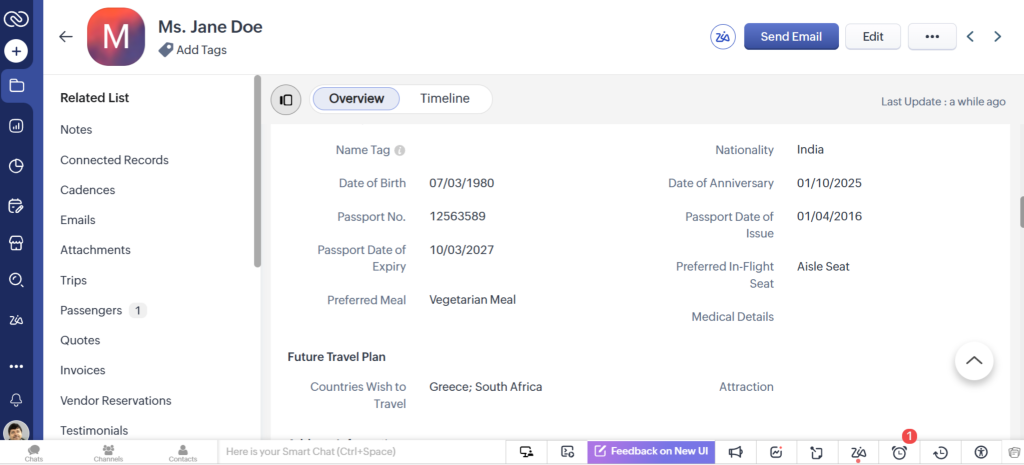
A well-designed Travel Agency CRM centralizes:
With this information always accessible, agents deliver highly relevant recommendations, close deals faster, and create experiences that drive repeat bookings and referrals, fueling sustainable sales growth.
Scaling travel sales requires clarity at every stage of the enquiry lifecycle. Without real-time visibility, managers rely on assumptions instead of data, making it harder to guide teams or protect active opportunities. The right Travel Agency CRM solves this by offering structured sales pipelines that reflect how travel enquiries actually progress.
Clear pipelines allow managers to track each enquiry from initial interest to confirmed booking. This transparency makes it easier to spot delays, understand deal momentum, and take timely action before opportunities stall.
A well-structured Travel Agency CRM helps managers:
With accurate visibility and actionable insights, managers move from reactive supervision to proactive leadership, driving stronger conversions and consistent sales growth.
Growth should simplify operations, not complicate them. As travel agencies expand, enquiry volumes rise, teams grow, and processes become more layered. The right Travel Agency CRM supports this growth without introducing confusion or operational friction.
A scalable CRM adapts to changing business needs instead of forcing agencies to rebuild systems every time they evolve. It allows teams to refine workflows, add new data points, and expand user roles while keeping day-to-day operations smooth and structured.
A future-ready Travel Agency CRM offers:
With the right foundation in place, agencies scale confidently, maintaining control, consistency, and sales efficiency at every stage of growth.
Doubling sales in a travel business is rarely about working harder. It’s about removing friction from every stage of the sales journey. The right Travel Agency CRM doesn’t promise instant results, but it systematically improves how enquiries are handled, nurtured, and converted. Over time, these improvements compound into measurable revenue growth.
When a CRM aligns with real-world travel sales processes, teams respond faster, follow up more consistently, and engage travellers with greater context. Enquiries no longer sit idle, proposals don’t get lost, and managers gain clear visibility into what’s working and what needs attention. Instead of relying on individual effort, sales performance becomes process-driven and repeatable.
A well-chosen Travel Agency CRM helps you 2X sales by strengthening key conversion drivers:
As a result, sales consultants spend more time advising and closing, not chasing updates. Managers focus on coaching and forecasting instead of firefighting. Travellers experience smoother, more professional journeys from enquiry to confirmation. This is how the right Travel Agency CRM turns everyday sales improvements into sustained 2X growth, practically, predictably, and without burning out your team.
Selecting the right Travel Agency CRM goes far beyond adopting new software. It’s a business decision that directly impacts how efficiently your team sells, follows up, and converts enquiries into confirmed bookings. A CRM that truly fits the travel industry supports long sales cycles, complex trip requirements, and high-touch customer interactions without adding operational friction.
When your CRM manages leads, trips, proposals, follow-ups, and sales visibility in one connected system, your team spends less time managing data and more time engaging travellers with confidence. Processes become consistent, follow-ups become reliable, and opportunities stop slipping through the cracks. Over time, these small improvements add up,helping agencies scale bookings without scaling effort.
If your objective is to grow revenue sustainably and achieve 2X sales with the same team, choosing the right Travel Agency CRM is a critical step forward. Book a one-on-one consultation with our Zoho CRM experts to evaluate your sales process, identify gaps, and design a CRM strategy tailored to your travel business goals.