
The travel industry doesn’t slow down. Inquiries arrive from every direction, clients expect immediate responses, vendors need confirmations, and payments must be tracked without error. During peak season, even a small delay or missed follow-up can mean losing a booking, or worse, losing a loyal client. Many growing agencies start with spreadsheets, inbox folders, and scattered chats. It works… until it doesn’t. As volume increases, chaos quietly replaces control. That’s when investing in the right CRM for travel businesses stops being a technology decision and becomes a survival decision.
The challenge? Not every CRM understands how a travel business actually operates. A generic system may organize contacts, but it won’t structure itineraries, vendor reservations, passenger-level details, and trip profitability in a meaningful way.
So, if you’re evaluating a Travel Agency CRM software, here are the ten capabilities that truly matter, not just as features on paper, but as operational foundations for long-term growth.
In a travel agency, inquiries rarely arrive in a single, organized stream. A potential client might first message on Instagram about a Bali package, fill out a website form two days later, and then call your office asking for a honeymoon quotation. Without structure, these interactions sit in different places, often with different team members, leading to confusion and missed opportunities.
That’s where a well-designed CRM for travel businesses becomes critical.
During peak season, your team might receive 40–50 inquiries per day across WhatsApp, email, referrals, paid ads, and website forms. The challenge isn’t generating leads but managing them systematically. An effective CRM centralizes every inquiry and moves it through a clearly defined sales journey. More importantly, an industry-specific solution understands travel intent. Instead of simply capturing contact details, it structures inquiries around destination, travel dates, budget range, and passenger count. This allows your sales team to respond with relevance and speed rather than guesswork.
Your CRM should allow you to:
This structured system ensures no inquiry is forgotten, even during high-demand travel seasons..
Travel bookings are rarely straightforward. A Europe tour may involve multiple cities, visa documentation, hotel upgrades, sightseeing arrangements, and special preferences. Managing this through email threads quickly becomes chaotic. A proper CRM for travel businesses must reflect this operational depth. Instead of storing only contact records, your CRM should allow trip-specific records under each client. This ensures that every journey is managed independently, with clarity and precision.
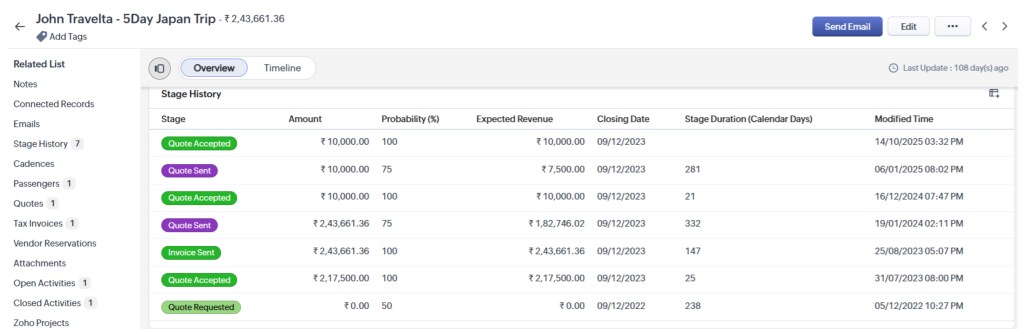
A specialized industry solution understands that travel businesses operate around journeys, not just contacts. That’s why trip-level management should be a core structural element, not an afterthought customisation.
Your CRM should support:
When a client calls about Day 4 of their itinerary, your team should be able to access that instantly. That level of organization transforms service delivery.
In the travel industry, speed is an influence. When a client inquires about a honeymoon in Maldives or a family trip to Switzerland, they rarely wait for just one proposal. They compare options. And the agency that responds quickly, with clarity and professionalism, often wins the booking.
Manually building quotations in spreadsheets or copying itineraries into Word documents slows your team down. It increases calculation errors, inconsistent formatting, and delayed responses. Over time, this affects conversion rates.
A well-built CRM for travel businesses should streamline quotation generation into a structured and repeatable process. Instead of preparing every proposal from scratch, your team should be able to work with pre-defined components tailored to travel operations.
Your CRM should allow:
An industry-designed solution goes a step further by linking quotations directly to trip records, vendor rates, and projected profitability. This ensures that what you quote aligns with your operational capacity and margins. When quotation creation becomes fast and structured, your sales team spends less time formatting documents and more time building relationships, which is where real conversions happen.
Behind every seamless vacation is coordinated vendor execution. Hotels, airlines, transport providers, and tour operators all play a role in delivering the final experience. Managing vendor details across spreadsheets and inboxes increases risk and reduces margin control.
A strong CRM for travel businesses should centralize vendor management within the operational flow. In our industry-tailored solution, vendor records are not isolated databases. They are directly linked to trips, quotations, and financial records, giving you a complete operational view.
Your CRM should help you:
This level of customization ensures pricing accuracy, payment clarity, and stronger supplier relationships
Group travel is where operational cracks start to show. Handling 20 travelers under one fixed departure isn’t just “one booking multiplied.” It’s a moving system of seat allocations, room sharing preferences, payment schedules, visa documentation, and last-minute changes. One traveller may pay in full upfront, while another pays in instalments. One may request an upgrade. Another may cancel. Without structure, this quickly turns into spreadsheet chaos.
A well-built CRM for travel businesses should treat fixed departures as structured operational units, not just standard bookings grouped together. Because in reality, group tours operate like mini-projects within your business. The Travel Agency CRM understands this complexity. Instead of forcing you to manage group details manually, it centralizes everything under one departure record while still maintaining individual-level visibility.
Your CRM should allow you to:
For example, if only three seats remain for your December Europe departure, your sales team should see that instantly before committing to a new inquiry. At the same time, your finance team should clearly see who has paid, who has pending balances, and what vendor payments are due.
This unified visibility reduces errors, improves internal coordination, and protects profitability. As your agency scales its fixed departures, structured group management isn’t just helpful. It becomes essential for sustainable growth.
Closing a booking is only half the job. Execution defines your reputation.
Imagine confirming a group departure for 15 travelers to Singapore. Flights are reserved, hotel rooms blocked, transfers arranged, but one hotel confirmation is delayed and goes unnoticed. A small oversight can create operational chaos.
This is why structured booking visibility is critical.
A reliable CRM for travel businesses should provide real-time clarity on reservation status. Instead of tracking confirmations through emails and personal reminders, your entire team should operate from a centralized system.
Your CRM should enable:
An industry-focused solution integrates booking confirmation directly with vendor coordination and financial tracking. This ensures that once a deal moves from “Confirmed” to “Operational,” nothing falls through the cracks. Operational discipline is what turns first-time clients into repeat travelers.
Travel decisions are emotional and often require multiple touchpoints.
A client may request a Europe package today, ask for modifications next week, and confirm only after comparing multiple agencies. If follow-ups depend solely on individual memory, opportunities will inevitably slip away.
A structured CRM for travel businesses ensures that communication is timely, consistent, and professional.
Your system should support:
For example, if a quotation remains unattended for 48 hours, the system can prompt your sales consultant to reconnect. Similarly, automated pre-travel emails ensure clients receive tickets and vouchers on time. Our Travel Agency CRM blends communication with booking lifecycle, ensuring that messages align with trip stages. Automation does not replace personalization, it reinforces reliability.
No two travel agencies operate in exactly the same way. Some require managerial approval before sending high-value quotations. Others follow milestone-based payment cycles or specialized visa documentation processes. A rigid system can restrict operational flexibility and force your team into inefficient workarounds.
A scalable CRM for travel businesses should adapt to your business model rather than forcing you to adapt to the software.
Look for capabilities such as:
For instance, your finance team may require visibility into payment statuses, while sales consultants focus on lead progression. Role-based access ensures operational clarity without compromising control.
An industry-designed CRM is built with travel workflows in mind but still allows flexibility for agency-specific processes. As your business evolve, whether expanding into group tours, luxury travel, or corporate bookings, your CRM should evolve with you.
Travel businesses operate with layered financial structures, advance payments, installment plans, vendor payouts, commissions, and occasional refunds Without structured tracking, agencies often struggle to answer critical questions like: “Did we actually make profit on this departure?”
A capable CRM for travel businesses should integrate financial tracking directly into the booking lifecycle rather than relying on disconnected accounting sheets.
Your CRM should allow you to:
An industry-focused solution links financial data with vendor payments and quotations, providing real-time visibility into margins.
For example, if vendor rates increase unexpectedly or discounts are applied to secure a booking, the impact on profitability should be immediately visible. Structured financial clarity protects margins and supports confident scaling.
As your agency grows, relying on instinct alone is no longer sustainable. Decisions need to be backed by clear, structured, and real-time data.
A comprehensive CRM for travel businesses should provide visibility across sales, operations, and finance. But when the system is designed as an industry solution for travel agencies, reporting becomes far more contextual and actionable. It reflects the way travel businesses actually operate.
An industry-focused CRM enables agencies to analyze performance across key travel-specific parameters such as:
For example, if Maldives packages generate higher margins than Europe tours during a specific quarter, that insight directly influences marketing allocation, pricing adjustments, and supplier negotiations.
Similarly, identifying which lead sources consistently convert high-value bookings allows agencies to invest confidently in the right acquisition channels. With a travel industry CRM solution, reporting is not just about numbers. It conn
A travel business operates in a constantly moving environment. It blends sales, itinerary planning, vendor coordination, financial management, and customer communication, often within tight timelines and high client expectations.
A generic CRM may help store contacts and track basic interactions. However, it rarely supports the layered structure required to manage quotations, bookings, vendor reservations, payment schedules, and traveler documentation in one connected workflow. This is where a dedicated industry solution for travel agencies makes a measurable difference. Instead of forcing your team to adapt to a rigid system, the right CRM mirrors your operational flow, from inquiry to trip completion.
When evaluating a CRM for travel businesses, consider whether the system:
The right system does more than organize data. It reduces operational friction, improves internal collaboration, and enhances the client experience at every touchpoint. In an industry built on delivering seamless travel experiences, operational efficiency becomes your strongest competitive advantage. A structured, scalable CRM ensures your growth does not create complexity; it creates control.
If you’re exploring a CRM for travel businesses that truly reflects how your business work, from inquiries and itineraries to vendor coordination and profitability tracking, it’s time to move beyond spreadsheets and disconnected tools.
Book a consultation with our team to see how an industry-designed travel CRM can bring structure, clarity, and growth to your agency.
Let’s build a system that works the way your travel business does.