
Businesses today rely on multiple applications to manage CRM, finance, customer support, and industry-specific processes. However, standard applications do not always meet every business requirement. This is where Zoho Catalyst business applications can help businesses address requirements that go beyond the capabilities of their existing software.
Companies may need a custom customer portal, a specialized operational application, a unique booking experience, or integrations that connect existing systems through APIs. These requirements often go beyond simply adding features to an existing platform. They require a technology foundation that can support the application interface, backend logic, data, APIs, authentication, integrations, and deployment.
Zoho Catalyst provides this foundation as a full-stack cloud platform for building and deploying custom applications and backend services. It brings capabilities such as Functions, AppSail, data storage, authentication, API management, application hosting, and front-end deployment into one ecosystem.
For businesses, the value of Catalyst lies not just in the services it offers, but in what those capabilities make possible—from extending existing Zoho solutions to building applications around unique business requirements.
Catalyst is a pro-code platform by Zoho that provides the foundation for developing and deploying custom digital applications. Instead of starting with a fixed application structure, businesses can build the technology around their specific requirements.
This could include:
Zoho Catalyst provides the backend and cloud services needed to support these applications while allowing developers to build the application experience according to the business requirements. This makes Catalyst particularly relevant when a business needs more than a conventional business process application.
The real strength of Zoho Catalyst lies in the level of flexibility it provides.
A business can define how the application should look, how it should behave, how its backend should work, how it should communicate with other systems, and how it should be deployed. Here are some of the capabilities that make Catalyst particularly powerful.
One of the most significant capabilities of Zoho Catalyst is the freedom to create the applications front-end experience.
Through Catalyst Slate, businesses can deploy modern web applications built using popular JavaScripts. Slate supports these deployments, application previews, custom domains, and automated deployment workflows. This means the user experience does not have to follow a predefined application interface.
A business can create an interface specifically for:
For example, a travel company could create a branded customer portal where travelers can log in, review their trips, upload documents, make requests, and track booking information. The customer sees a digital experience designed around the travel company’s process.
Behind that experience, Catalyst can provide the application services and integrations required to support it.
A custom application is not only about functionality. The user experience matters just as much. Different users may need completely different interfaces for the same underlying business process.
Zoho Catalyst makes it possible to create these experiences around the requirements of each user group. This opens the door to applications that feel like the company’s own digital product, rather than simply another business tool.
A polished interface is only one part of a digital application. Behind it, the application needs business logic.
It may need to validate information, process transactions, calculate values, retrieve data, trigger actions, communicate with other systems, and manage application-specific processes. Catalyst provides backend capabilities through services such as Catalyst Functions and AppSail. Functions provide backend logic for applications and microservices, while AppSail provides a managed platform for deploying applications with custom runtime support.
For a business, this means custom logic can become part of the application itself.
For example:
A customer submits a request → the application validates the information → business rules are applied → relevant CRM information is retrieved → the request is processed → the appropriate system is updated → the customer receives an update.
The application can support the complete process instead of relying on employees to coordinate every step manually.
Every organization has processes that are unique to the way it operates.
Consider a manufacturer that has its own quality-checking rules. Or a travel company with a specialized booking process. Or a distributor with a complex dealer approval process. These processes may involve multiple conditions, calculations, approvals, and system updates.
Zoho Catalyst allows these rules to become part of the application’s backend. Instead of adapting the business process to fit a generic application, businesses can build the application around the process. This is one of the most important reasons to consider Catalyst for specialized requirements.
Modern businesses rarely operate on a single system. A typical technology environment may contain:
Website + CRM + ERP + accounting + payment gateway + external APIs + custom applications
The challenge is getting these systems to communicate effectively.
Catalyst provides API capabilities and an API Gateway that can act as an intermediate layer between clients and application services. It can manage routing, authentication, and throttling for supported API requests. This creates an opportunity to build a connected technology environment.
The custom application becomes the experience that users interact with, while Catalyst can help coordinate the systems working behind it.
A business does not necessarily need to replace its existing software to introduce a custom application. Instead, Catalyst can become an additional technology layer.
For example:
Zoho Catalyst applications can sit around these systems and address the specific requirement that existing applications cannot handle on their own.
This creates a more connected architecture. The goal is not to replace everything. The goal is to connect the right technologies and build the missing layer.
Not every business requirement needs to become one large application. Sometimes a business needs a specific service that performs one important function.
For example:
Catalyst Functions can support backend logic for applications and microservices, allowing specialized functionality to operate as individual components. This approach can help businesses create applications that are easier to expand as their requirements evolve.
Custom applications often have data requirements that are specific to the application itself. Catalyst provides data storage capabilities that can support the application’s own structured data and storage requirements.
This can be useful when an application needs to maintain:
The result is an application with its own technology foundation rather than one that depends entirely on spreadsheets or manually maintained databases.
Automation does not always have to exist as a separate workflow. With Catalyst, automation can become part of the application architecture.
Catalyst provides services such as Circuits for orchestrating multi-step workflows and Job Scheduling for recurring processes. Its Job Scheduling service can trigger functions, Circuits, webhooks, and AppSail services.
For example, an application could automatically:
This allows operational processes to become part of the application rather than remaining dependent on manual intervention.
Building an application is only part of the process. It also needs to be deployed, tested, updated, and maintained.
Catalyst Slate provides a dedicated front-end deployment environment for web applications. Developers can deploy applications through Git repositories, direct uploads, or the Catalyst CLI. Slate can also provide preview environments, custom domain mapping, SSL, and automated deployments.
This creates a more structured path from:
Development → Testing → Deployment → Production
For businesses, that means the application can continue evolving as requirements change.
The possibilities depend on the business requirement, but several use cases stand out.
Customer Portals: Businesses can create dedicated portals where customers can access information, submit requests, upload documents, or track processes.
Partner and Dealer Portals: Distributors and partners can receive a dedicated interface for orders, requests, information, and operational activities.
Industry-Specific Applications: Businesses can build applications around specialized processes that are unique to their industry.
For example:
Manufacturing quality applications
Custom Internal Applications: Departments can have dedicated applications for processes that require specialized workflows, calculations, approvals, or interfaces.
Integration Applications: Catalyst can also support applications whose primary purpose is to connect different systems and coordinate information between them.
One of the most powerful ways to think about Catalyst is not as another isolated application.
Think of it as a technology layer connecting a custom digital experience with the systems behind the business.
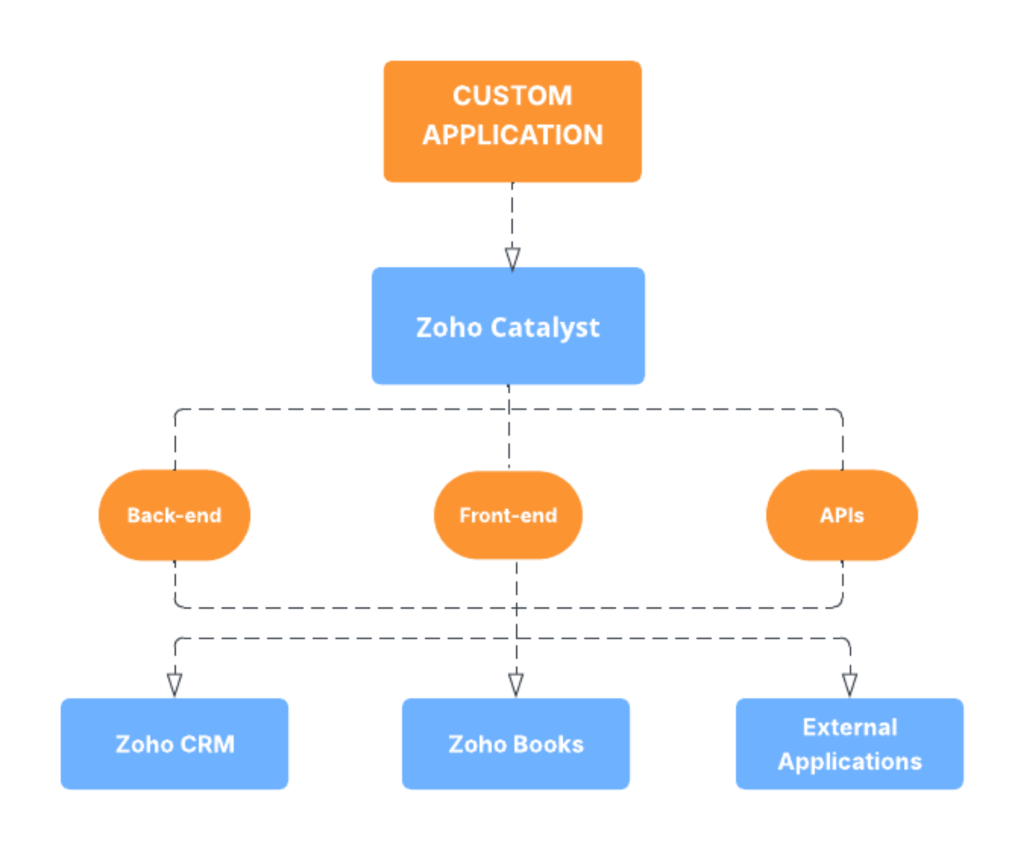
This architecture can allow a business to create a completely custom experience while continuing to use the systems that already support its operations.
That is where Catalyst becomes particularly valuable.
Catalyst becomes worth exploring when the requirement goes beyond simply managing a standard business process.
Consider Catalyst when your business needs:
A completely customized web application
The starting point should not be the technology itself. It should be the business requirement.
Ask: What does our business need to deliver that our current technology cannot provide effectively?
That question can reveal where a custom application could create real value.
Businesses do not always need another off-the-shelf application. Sometimes they need something specific to the way they operate.
Zoho Catalyst provides the technology foundation for building these experiences.
It brings the front end, backend, data, APIs, integrations, automation, and deployment capabilities together so businesses can create applications around their requirements. The real opportunity is therefore not simply to build another application. It is to build a digital solution that becomes part of the way the business operates.
As a Zoho partner, we help organizations understand their requirements, identify such gaps in their existing systems, and determine the most appropriate technology approach. For businesses exploring Catalyst, here are our experts to help you.