

The manufacturing sector is undergoing rapid transformation. Rising customer demands, supply chain disruptions, and growing operational costs are reshaping manufacturing operations. As businesses grow, managing production, inventory, procurement, finance, and customer fulfilment becomes increasingly complex. This is exactly where Zoho ERP for manufacturing businesses is becoming a strategic advantage, helping organizations bring every critical process under one connected system.
Many manufacturers begin their journey using spreadsheets, manual paperwork, or multiple disconnected applications to manage operations. While these methods may work in the early stages, they often create bottlenecks as the business grows. Delayed production schedules, inaccurate inventory records, procurement inefficiencies, and limited financial visibility can directly impact profitability and customer satisfaction.
In this blog article, we will learn how a unified ERP ecosystem enables manufacturers to automate workflows, gain real-time insights, and build scalable operations with confidence.
Manufacturing is one of the most demanding and process-driven industries, where every function, from sourcing raw materials and planning production to managing inventory and delivering finished products, must work in perfect coordination. As businesses grow, managing these operations through spreadsheets, paperwork, or disconnected software often creates inefficiencies that slow progress and affect profitability. Communication gaps between departments, inaccurate stock records, delayed production cycles, procurement challenges, and limited cost visibility can quickly become everyday obstacles.
This is where Zoho ERP for manufacturing businesses becomes a strategic necessity rather than just a technology upgrade. By connecting core departments through one centralized system, ERP enables manufacturers to automate workflows, improve operational visibility, and make faster, data-driven decisions. With the right ERP solution in place, manufacturing businesses can reduce operational complexity, improve productivity, and build a scalable foundation for long-term growth.
In many manufacturing businesses, departments such as production, procurement, sales, inventory, and finance often operate on separate systems. This lack of connectivity creates communication gaps, duplicate data entries, and delays in decision-making. When teams cannot access shared real-time information, productivity suffers, and operations become harder to manage.
Without real-time inventory visibility, manufacturers often face stock shortages or overstocking issues. Missing critical raw materials can delay production, while excess inventory increases storage costs and blocks working capital. Accurate inventory management is essential for maintaining smooth production cycles and profitability.
Production schedules depend on material availability, machine capacity, workforce allocation, and order priorities. Without clear visibility across these areas, delays become common. Missed deadlines can affect customer trust, damage business reputation, and create pressure across operational teams.
Many manufacturers still rely on manual purchase requests, vendor communication, and approval processes. These outdated methods often cause delays in sourcing materials and increase the chances of human error. Inefficient procurement directly affects production continuity and supplier coordination.
Tracking actual production costs becomes difficult when operational and financial data are disconnected. Businesses often struggle to accurately measure raw material costs, labour expenses, overheads, and wastage. Without clear cost visibility, pricing decisions and profitability analysis become less reliable.
Manufacturing leaders need real-time insights to make informed decisions. When reporting is scattered across multiple tools, leadership teams often rely on outdated information. This makes it harder to identify operational bottlenecks, forecast demand, or respond quickly to market changes.
Modern manufacturing businesses require more than standalone software or manual systems to manage growing operational demands. As production cycles become more complex and customer expectations continue to rise, manufacturers need a connected system that can bring every department, process, and data point together. This is where Zoho ERP becomes a powerful business solution. Built to support end-to-end operational management, Zoho ERP helps manufacturers streamline production, inventory, procurement, finance, and quality processes through one unified platform.
Instead of working with disconnected spreadsheets or multiple applications, teams can access real-time data, automate workflows, and make faster business decisions. Its cloud-based flexibility, scalability, and customization capabilities make it suitable for both growing and established manufacturing businesses.
To stay competitive in today’s fast-moving market, manufacturers need complete visibility and control across every stage of operations. From production planning and inventory tracking to procurement, quality checks, and financial management, every process needs to work in sync. This is where Zoho ERP delivers real value to the manufacturing businesses. By combining automation, real-time data, and connected workflows, Zoho ERP helps manufacturers reduce manual effort, improve operational accuracy, and make faster business decisions. Below are some of the core features that make Zoho ERP a powerful solution for modern manufacturing businesses.
Efficient production begins with accurate planning. Zoho ERP helps manufacturers create structured production schedules based on customer demand, sales forecasts, machine availability, inventory levels, and workforce capacity. With better visibility into resources and production timelines, businesses can reduce bottlenecks, improve resource utilization, and consistently meet delivery commitments.
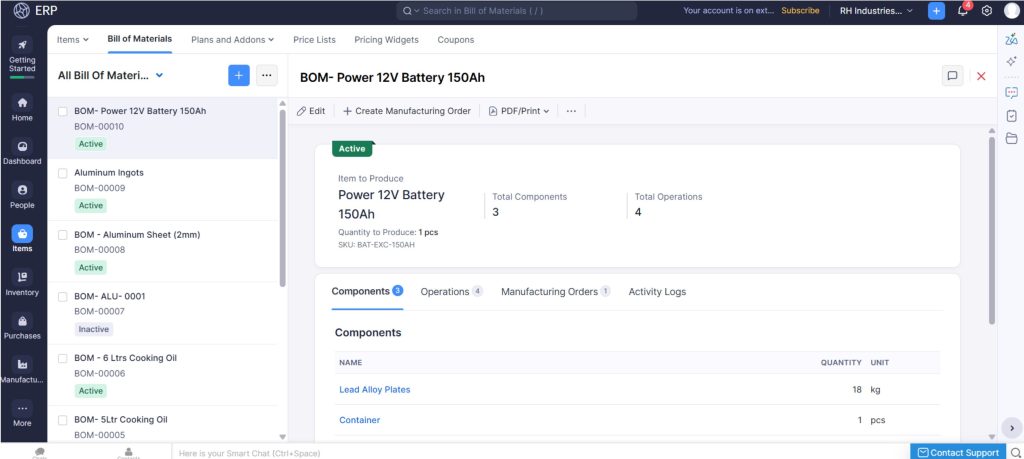
Every product requires precise planning of materials, quantities, and production steps. Zoho ERP allows manufacturers to create and manage detailed BOMs, including raw materials, assembly instructions, routing processes, and sub-assemblies. This helps production teams maintain consistency, reduce errors, and ensure standardized output across manufacturing batches.
Managing inventory efficiently is critical for uninterrupted production. With Zoho ERP, manufacturers can track raw materials, finished goods, batch numbers, warehouse transfers, and reorder levels in real time. This improves stock accuracy, reduces wastage, and helps maintain optimal inventory levels across locations.
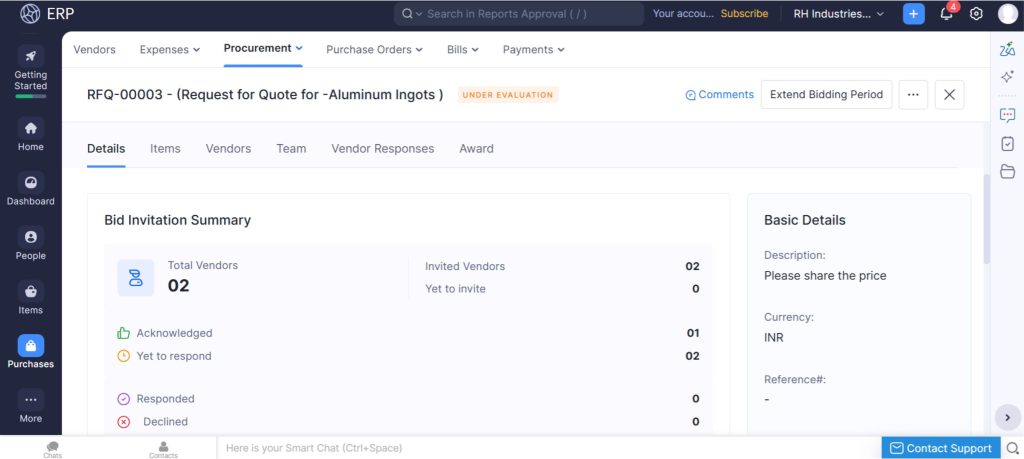
Timely procurement directly impacts production continuity. Zoho ERP automates purchase requests, vendor quotations, purchase orders, approvals, delivery tracking, and payment processes. By connecting procurement with production and inventory data, businesses can make faster purchasing decisions and strengthen supplier coordination.
Maintaining product quality is essential for customer satisfaction and long-term business growth. Zoho ERP allows manufacturers to build quality inspection workflows for incoming materials, in-process production checks, final product inspections, and batch approvals. This ensures quality consistency while simplifying audit and compliance management.
Understanding production costs is essential for profitability. With Zoho ERP’s accounting capability, manufacturers can track raw material expenses, labor costs, overheads, vendor payments, and product margins in real time. This enables better financial planning and smarter pricing decisions.
Every manufacturing business has unique operational processes. With Zoho ERP, businesses can build custom workflows for production approvals, machine maintenance, work order tracking, quality checklists, and task management. This flexibility makes the system adaptable to different manufacturing models.
Business growth depends on informed decision-making. The reporting capability of Zoho ERP provides live dashboards for tracking production efficiency, machine utilization, procurement cycles, inventory turnover, vendor performance, and profitability. This helps leadership teams identify bottlenecks early and make faster, data-driven decisions.
Implementing Zoho ERP for manufacturing businesses creates a measurable impact across every area of operations. From improving production efficiency and inventory control to strengthening financial visibility and decision-making, Zoho ERP helps manufacturers build a more connected and scalable business environment. By automating manual processes and centralizing operational data, businesses can reduce inefficiencies, improve coordination between departments, and respond faster to market demands. Below are some of the key benefits manufacturers experience after implementing Zoho ERP.
As manufacturing businesses continue to face growing operational complexity, rising customer expectations, and increasing pressure to improve efficiency, having the right technology in place is no longer optional. Managing production, inventory, procurement, finance, and quality processes through disconnected systems can slow growth and limit business visibility. This is where Zoho ERP for manufacturing businesses creates real value. By bringing critical operations together on one connected platform, manufacturers can streamline workflows, improve resource utilization, gain real-time business insights, and make faster, more confident decisions.
Whether you are looking to reduce production bottlenecks, improve inventory accuracy, strengthen cost control, or scale operations more effectively, Zoho ERP provides the flexibility and control needed to support long-term growth in a competitive market.
If your manufacturing business is ready to modernize operations and build a smarter, more connected future, now is the right time to take the next step. Connect with our experts today and discover how Zoho ERP can transform your manufacturing operations.