

Running a small business today is more challenging than ever. Teams often manage multiple software applications for sales, accounting, inventory, customer support, marketing, and human resources. While these tools may solve individual problems, they often create disconnected workflows and scattered data. As businesses grow, these disconnected systems become difficult to manage. Employees spend more time switching between applications, updating records manually, and correcting errors. This reduces productivity and limits growth opportunities. This is where enterprise resource planning (ERP) systems become valuable.
According to Statista, the global ERP software market has shown consistent growth over the past decade, with worldwide ERP software revenues continuing to increase through 2024. This growth reflects the rising demand for integrated business management systems that help organizations streamline operations, improve visibility, and automate processes.
An ERP system brings critical business functions together on a unified platform. It connects departments, centralizes information, and automates processes across the organization. For many startups and growing companies, finding an ERP solution that balances functionality, affordability, and scalability can be difficult. Fortunately, Zoho ERP for small businesses offers a practical solution. Built on the extensive Zoho ecosystem, Zoho ERP enables businesses to manage operations from a single platform while maintaining flexibility for future growth.
In this guide, we will explore why Zoho ERP for small businesses has become a preferred choice for startups, small businesses, and mid-sized organizations seeking operational efficiency and long-term scalability.
Zoho ERP is a comprehensive business management solution that helps organizations manage multiple business functions through a connected and centralized system. Unlike traditional ERP platforms that often require complex infrastructure and significant investments, Zoho ERP offers a flexible ecosystem built using various integrated Zoho applications. This allows businesses to manage their operations efficiently while maintaining complete visibility across departments.
At its core, Zoho ERP for small businesses connects essential business processes that are often managed through separate software applications. Instead of switching between different systems for sales, accounting, inventory, customer service, and human resources, businesses can access and manage everything from a unified platform. This creates a more streamlined workflow and ensures that data remains consistent across the organization.
Some of the key business functions managed through Zoho ERP include:
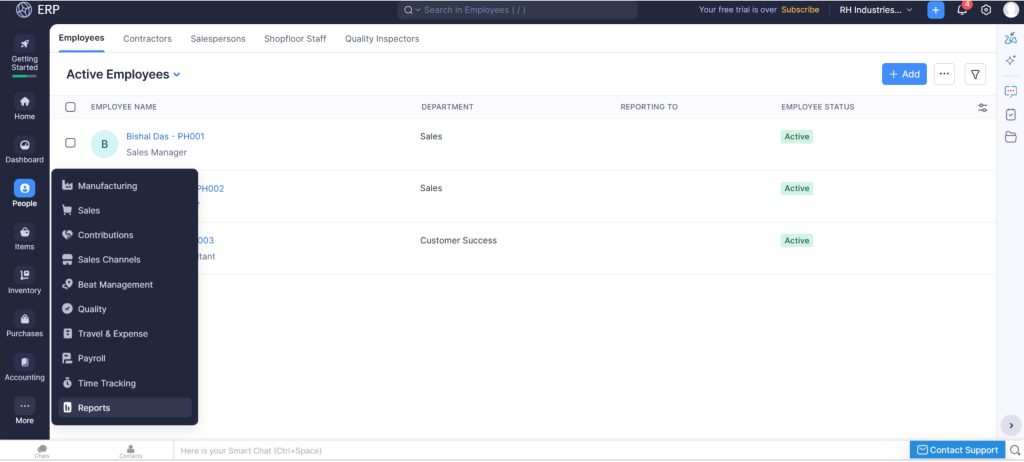
One of the biggest advantages of Zoho ERP is the seamless flow of information between departments. For example, when a sales representative closes a deal, the system can update inventory records, generate an invoice, notify the finance team, and update customer information. This reduces manual data entry, minimizes errors, and improves operational efficiency.
For startups, growing companies, and mid-sized organizations, Zoho ERP for small businesses provides a scalable and cost-effective way to unify operations, automate processes, and support long-term business growth. By bringing people, processes, and data together, it helps businesses operate smarter and make better decisions every day.
Many small businesses begin their journey with simple tools such as spreadsheets, accounting software, and standalone applications. In the early stages, these tools often seem sufficient. However, as the business grows, operations become more complex. Teams expand, customer data increases, and processes become harder to manage. What once worked efficiently can quickly turn into a source of delays, errors, and confusion.
This is where an ERP system becomes essential. Instead of managing information across multiple disconnected platforms, businesses can centralize their operations within a single system. An ERP solution creates a connected environment where every department works with the same data, improving collaboration and productivity. For growing companies, adopting Zoho ERP for small businesses can provide the structure needed to support sustainable growth while reducing operational challenges.
Many businesses use separate tools for sales, accounting, inventory, and customer service. As data grows, maintaining accuracy becomes difficult. Employees often spend hours updating records across different systems. An ERP platform eliminates these silos by creating a single source of truth for business information.
Manual processes can slow down daily operations and increase the risk of errors. Tasks such as invoicing, inventory tracking, employee onboarding, and customer follow-ups often require significant effort. ERP automation reduces repetitive work and allows teams to focus on revenue-generating activities.
Business leaders need accurate information to make confident decisions. ERP systems provide real-time visibility into sales, finances, operations, and performance metrics. This helps organizations identify opportunities and address challenges quickly.
Processes that work for a small team may not support a growing organization. ERP systems create standardized workflows that scale alongside the business. This allows companies to grow without increasing administrative complexity, making Zoho ERP for small businesses a valuable long-term investment.
The strength of Zoho ERP for small businesses lies in its ability to connect different business functions within a single ecosystem. Instead of relying on multiple disconnected applications, businesses can manage their operations through integrated tools that work together seamlessly. This improves efficiency, enhances visibility, and creates a more streamlined workflow across departments. Below are some of the key features that make Zoho ERP a powerful solution for growing businesses.
Customers are at the center of every successful business. Businesses can manage their customers within the ERP ecosystem, helping manage leads, opportunities, and customer interactions from a single platform. Teams can automate follow-ups, track sales activities, monitor sales, and forecast revenue more accurately. Since the data connects with other business functions, organizations gain a complete view of each customer relationship.
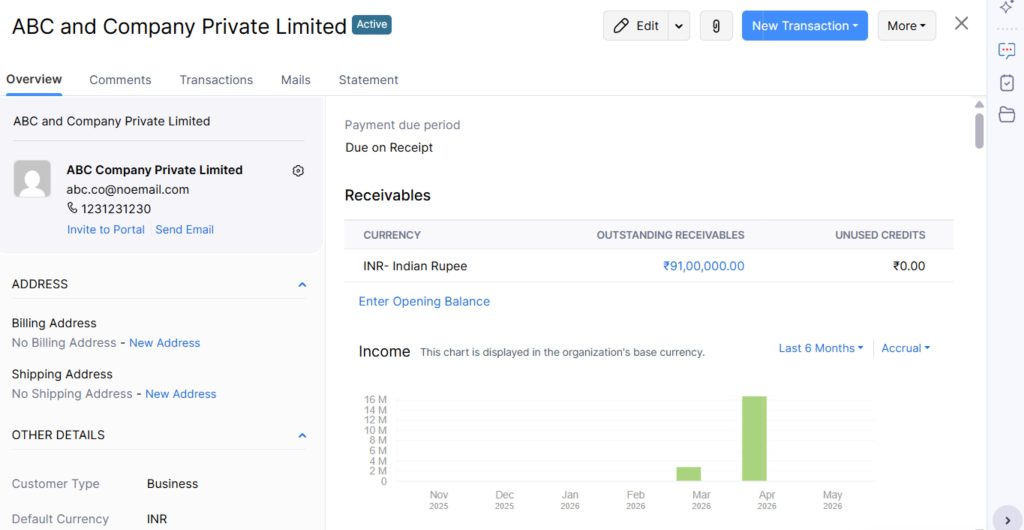
Financial visibility is essential for maintaining healthy business operations. With Zoho ERP businesses can manage invoices, expenses, purchase orders, tax compliance, bank reconciliations, and financial reports. Automated accounting workflows reduce manual effort while improving financial accuracy and reporting capabilities.
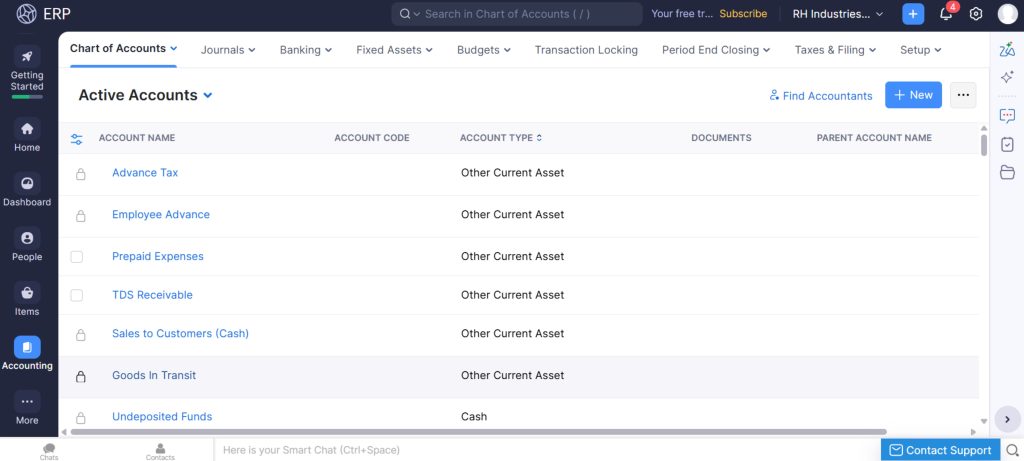
Effective inventory control directly impacts profitability and customer satisfaction. Zoho ERP helps businesses monitor stock levels, manage warehouses, track product movement, handle purchase orders, and automate replenishment processes. This ensures businesses maintain optimal inventory levels while avoiding stock shortages or overstocking.
Project-based businesses require clear visibility into tasks, timelines, and resources. Zoho ERP enables teams to assign tasks, track progress, manage deadlines, monitor budgets, and improve collaboration. This helps organizations complete projects more efficiently while maintaining accountability across teams.
Business growth depends on informed decision-making. The analytics feature provides real-time dashboards, performance reports, departmental insights, and customizable reporting tools. With access to accurate business data, leaders can identify opportunities, address challenges, and make strategic decisions with greater confidence.
Implementing an ERP system is a major decision for any growing organization. The right solution should not only solve current operational challenges but also support future business growth. This is where Zoho ERP for small businesses stands out. It combines affordability, flexibility, automation, and scalability within a single ecosystem. Unlike traditional ERP systems that can be expensive and complex, Zoho ERP is designed to meet the needs of startups, small businesses, and mid-sized organizations. Below are some of the key benefits that make it a preferred choice for growing companies.
Traditional ERP platforms often require significant investments in software, infrastructure, and implementation services. For many small businesses, these costs can be difficult to justify. Zoho ERP for small businesses provides enterprise-grade capabilities at a much lower cost, making advanced business management technology accessible to growing organizations.
Business requirements change as organisations expand. Zoho ERP follows a modular approach that allows businesses to start with essential applications and add new functionality when needed. This flexibility ensures that the system grows alongside the business and protects long-term technology investments.
Many ERP projects are known for lengthy deployment periods and complicated setups. Zoho ERP offers a more streamlined implementation experience through its cloud-based architecture and intuitive interface. This allows businesses to adopt the system faster and begin realizing value sooner.
Modern businesses require flexibility and mobility. Zoho ERP enables employees to access business information from anywhere with an internet connection. This supports remote teams, field staff, and businesses operating across multiple locations.
A survey of small and medium-sized enterprises found that a growing number of businesses are either already using cloud-based ERP systems or planning to move to cloud ERP solutions in the future. This shift highlights the increasing preference for flexible, scalable, and remotely accessible business management platforms. Cloud ERP solutions reduce infrastructure costs while providing businesses with easier deployment and ongoing scalability.
Automation helps businesses reduce manual effort and improve operational efficiency. Zoho ERP can automate several critical processes, including:
These automations improve consistency, reduce errors, and free teams to focus on higher-value activities.
Most businesses rely on multiple software solutions to run their operations. Zoho ERP integrates with various third-party applications, payment gateways, communication platforms, and eCommerce systems. This creates a connected ecosystem that supports diverse business needs and operational requirements.
As businesses grow, managing operations through disconnected tools becomes increasingly difficult. Separate systems for sales, finance, inventory, customer service, and employee management often create inefficiencies, duplicate work, and limited visibility. To remain competitive, growing organizations need a solution that brings these processes together within a single platform.
Did You Know?
The demand for ERP solutions continues to rise globally as businesses prioritize digital transformation and operational efficiency. Reports show steady growth in the worldwide ERP software market, while surveys show increasing adoption of cloud-based ERP systems among small and medium-sized businesses. In India, the ERP software market is also expanding rapidly as organizations invest in automation and connected business processes. These trends highlight why solutions such as Zoho ERP for small businesses are becoming an important part of modern business growth strategies.
Whether your goal is to improve efficiency, enhance customer experiences, or prepare for future growth, Zoho ERP offers the tools needed to support that journey. Investing in Zoho ERP for small businesses is not just about adopting new software; it is about creating a smarter, more connected, and growth-focused business for the future. Connect with our experts to know more.