
Managing clients in a professional services business involves much more than storing contact details. Teams need to capture enquiries, understand client requirements, manage consultations, send proposals, track follow-ups, coordinate internal activities, and maintain relationships long after a deal is closed. When teams handle these activities across spreadsheets, emails, and disconnected tools, client management can quickly become difficult to scale. Client management for professional services becomes more effective when businesses have a structured system that connects every client interaction. With client management in Zoho CRM, professional service firms can centralize client information, automate routine activities, manage follow-ups, and give teams a complete view of every client relationship.
Whether you run a consulting firm, legal practice, accounting firm, recruitment agency, marketing agency, or another professional service business, Zoho CRM can be customized around the way your team works. Instead of forcing your business into a rigid process, it can help you build a more consistent and scalable approach to managing clients.
Professional service businesses depend heavily on relationships. A client may interact with a sales representative, consultant, account manager, project team, and management before and after purchasing a service.
This creates a challenge.
Important information can become scattered across different places. One employee may have the client’s requirements in their email. Another may have meeting notes in a document. A third may be responsible for the next follow-up but have limited visibility into previous conversations.
This can lead to:
These problems may not be noticeable when a business has only a few clients. As the client base grows, however, they can affect productivity and the overall client experience.
A CRM provides the structure needed to avoid this fragmentation.
Client management in Zoho CRM can cover the entire journey from the first enquiry to ongoing client engagement. Instead of treating a CRM as a simple contact database, professional service firms can configure it as a centralized workspace for managing relationships.
A typical client journey could look like:
Enquiry → Qualification → Consultation → Requirement Analysis → Proposal → Negotiation → Client Onboarding → Service Delivery → Follow-Up → Repeat Business
Each stage can have its own activities, information, automation, and responsibilities.
This allows teams to understand not only who the client is, but also where the client is in the relationship and what needs to happen next. That distinction is particularly important for professional services.
One of the biggest advantages of using Zoho CRM for professional services is having client information available from a centralized system.
Instead of searching through emails or spreadsheets, employees can access relevant information from the client’s CRM record.
Depending on the business process, a client record can include:
This creates a more complete picture of the relationship.
For example, imagine a consulting firm receives an enquiry from an existing client about a new engagement. The consultant can review the client’s previous projects, conversations, proposals, and activities before responding.
Effective client management starts before someone becomes a client. Professional service firms may receive enquiries through websites, landing pages, advertisements, referrals, email campaigns, social media, or other channels.
Zoho CRM can help bring these enquiries into a structured process.
Website forms can capture information directly into CRM. Leads can then be assigned to the appropriate team member based on factors such as service type, location, source, or other business criteria.
For example, a consulting company could have separate enquiry paths for:
Each enquiry can be routed to the appropriate team. This reduces the need for employees to manually distribute enquiries and helps businesses respond faster.
More importantly, it creates consistency. Every enquiry enters a defined process instead of depending on someone remembering to update a spreadsheet or forward an email.
Not every enquiry is ready to become a client. Professional service businesses often need to understand a prospect’s requirements before deciding whether the engagement is suitable.
Zoho CRM can help teams create a structured qualification process.
Sales or consulting teams can capture information such as:
The team can then prioritize opportunities based on business criteria. This is especially useful when consultants handle multiple enquiries simultaneously. Instead of relying on memory, the CRM provides visibility into which prospects need attention and why.
Professional services are often relationship-driven. A successful consultation may determine whether a prospect becomes a client. However, a consultation alone does not guarantee conversion.
The follow-up process matters.
Zoho CRM can help teams schedule and track calls, meetings, tasks, and other activities associated with a client or prospect.
For example:
Initial consultation completed → Follow-up task created → Proposal prepared → Proposal sent → Follow-up reminder scheduled
This creates a repeatable process.
Sales representatives and consultants can see their upcoming activities and prioritize follow-ups without manually maintaining separate task lists. Managers can also get better visibility into whether important opportunities are being followed up on time.
Proposals are an important part of many professional service businesses.
Whether the business provides consulting, legal services, recruitment, accounting, design, or technology services, the proposal often represents the transition between interest and commitment.
Zoho CRM can help teams track this stage more systematically.
A typical process could include:
Requirement received → Proposal preparation → Proposal sent → Client review → Negotiation → Approval → Deal won
Each opportunity can be associated with the relevant client, activities, communications, and documents. This helps teams understand what is happening with every proposal. Instead of asking, “Did we follow up with this client?” or “What happened after we sent the proposal?”, the team can refer to the CRM record.
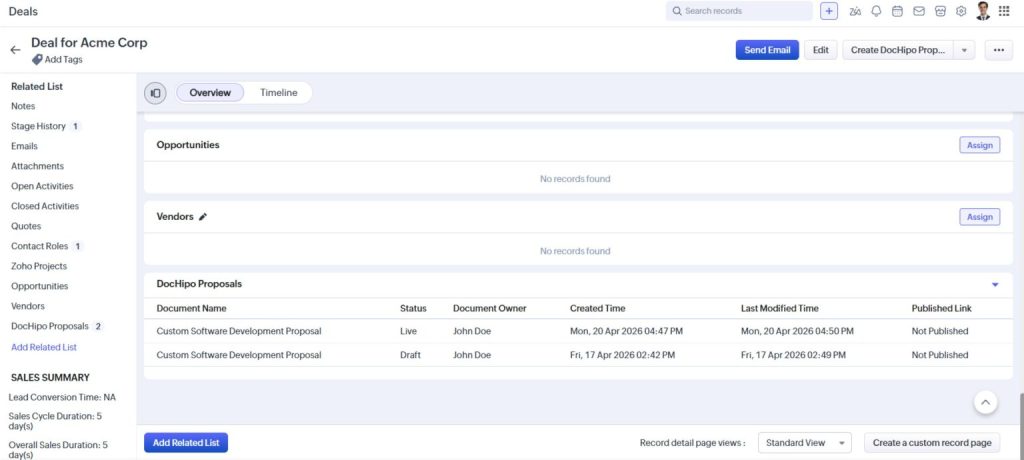
That visibility can make the sales process more predictable.
Client management involves many repetitive activities. Creating follow-up tasks, sending reminders, assigning enquiries, updating records, and notifying team members can consume valuable time.
Automation can reduce this manual effort.
For example, when a new enquiry is received, Zoho CRM can trigger a workflow that assigns the lead to the appropriate employee and creates a follow-up activity. Similarly, when a proposal reaches a particular stage, the system can help ensure that the next action is not forgotten.
A professional service firm could automate processes such as:
The objective is not to automate every interaction. It is to automate the repetitive administrative work so employees can spend more time on client conversations and service delivery.
A client relationship rarely belongs to just one person. A sales representative may bring the client into the business. A consultant may understand the requirements. A project manager may handle delivery. An account manager may manage the ongoing relationship.
Without a centralized system, each person may only see part of the relationship.
Zoho CRM can connect these interactions. When team members access the client record, they can understand the broader context of the relationship.
They can see relevant:
This becomes particularly valuable when responsibilities change or another team member needs to step in. The client experience becomes less dependent on one employee’s personal knowledge.
One common mistake is to think of CRM as a tool used only until a deal is closed.
For professional services, the relationship often becomes more important after the sale. Once a client signs an agreement, the business may need to coordinate onboarding, service delivery, documentation, meetings, renewals, or additional services.
Zoho CRM can support the transition into the next stage of the relationship.
For example:
Deal Won → Client Onboarding → Internal Task Creation → Service Handover → Follow-Up → Additional Requirement → New Opportunity
This helps businesses maintain continuity between sales and ongoing client management. It also creates opportunities for account expansion.
When the team has visibility into a client’s history and requirements, it becomes easier to identify when the client may need another service.
Good client management is not only about completing tasks. It is also about understanding the relationship. CRM data can help businesses identify patterns across their client base.
For example, managers can analyze:
These insights can help management identify where the client journey is working well and where improvements are needed.
Suppose a professional services company notices that many qualified prospects receive proposals but very few move forward. The issue may not be lead generation. It could be proposal turnaround time, follow-up frequency, pricing, or another part of the sales process.
CRM reporting can help businesses investigate these patterns instead of making decisions based only on assumptions.
Client management does not operate independently. Sales connects with proposals. Proposals connect with service delivery. Service delivery connects with billing and ongoing support.
Zoho’s ecosystem allows businesses to connect different processes as their requirements grow.
For example, a business may use Zoho CRM to manage prospects and clients while connecting it with other Zoho applications for areas such as:
This can help reduce information silos between departments. The result is a more connected business process rather than another isolated software system.
For many professional service firms, growth introduces a new challenge.
The business may have more leads, more clients, more employees, and more ongoing engagements. However, the processes used to manage those relationships may still depend heavily on spreadsheets, email threads, and individual employees.
That is where a CRM can create significant value.
A well-designed CRM process can help businesses:
The real value does not come from simply implementing CRM software. It comes from designing the CRM around the business.
Zoho CRM provides the technology, but the right implementation strategy determines how effectively it supports a professional service business.
A CRM should reflect the way your team captures enquiries, qualifies prospects, communicates with clients, prepares proposals, manages follow-ups, and develops long-term relationships. At GoldenLion Consulting, we help professional service businesses evaluate their existing processes and configure Zoho solutions around their specific requirements.
Rather than simply implementing standard CRM features, the focus is on creating practical workflows that support how your teams actually work. This can include CRM customization, automation, integrations, dashboards, custom modules, and process-specific workflows.
The objective is simple: make client management more structured without making it more complicated. Here are our experts to help you.